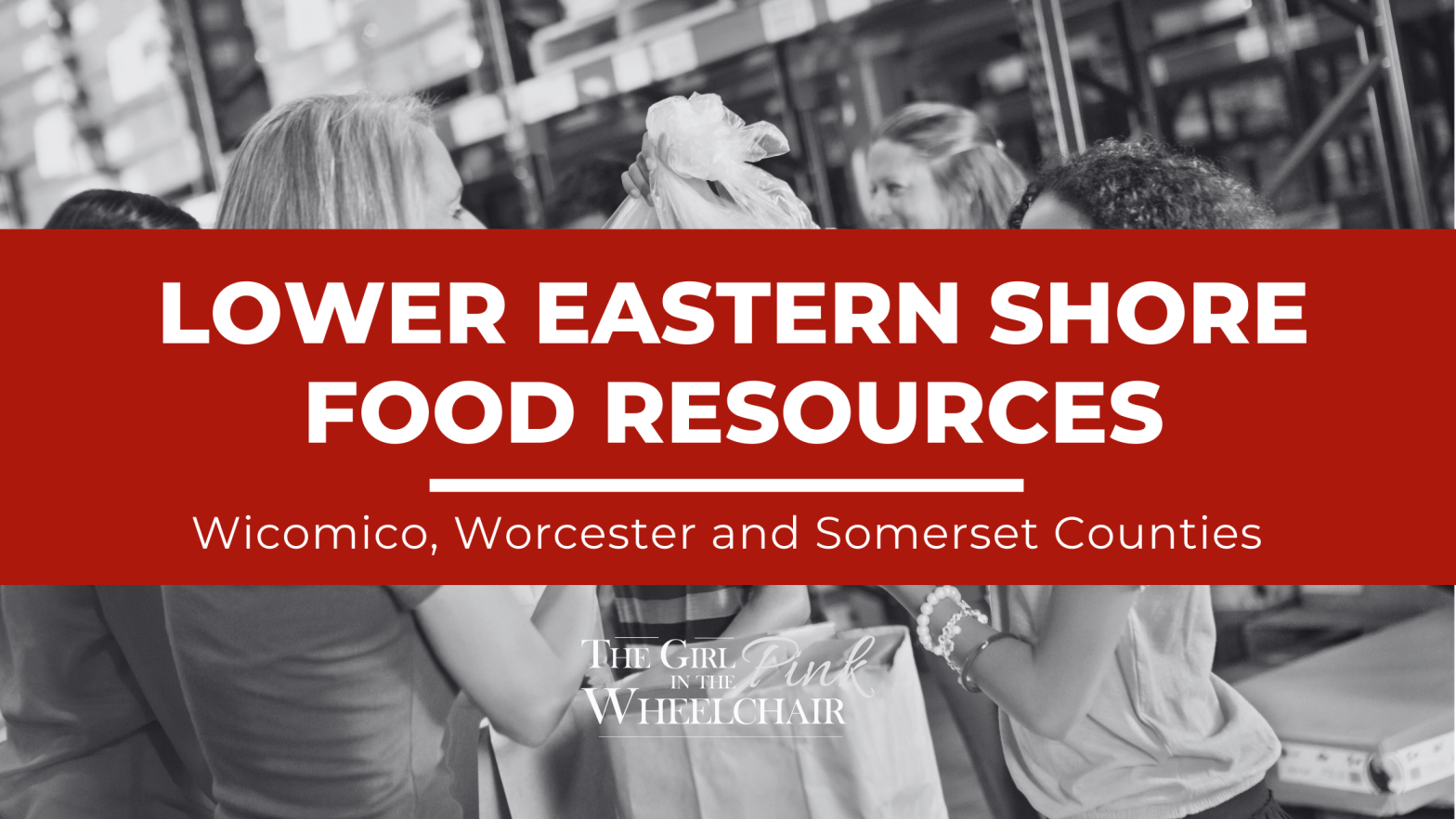
Image Description: a photo of people including a young girl receiving groceries and food items. Text on photo reads: “Lower Eastern Shore Food Resources: Wicomico, Worcester and Somerset Counties
This has been updated as of November 22nd 2025, but resources can change daily. Always double check!
This resource list is ALWAYS being updated. Make sure to come back to see when new resources are added.
If this format is not accessible, please email me at Hello@DomSessa.comor connect with me via social media.
If you would like to add resources or correct any information listed, please email me or connect with me via social media.
If you would like PDFs to share with your networks, please let me know!You can also share these posts by going onto my social media to share onto yours.
Please use and share these food resource guides for Wicomico, Worcester and Somerset with your friends, family, neighbors and networks!
They list food pantries, distributions, soup kitchens and more for each county.
Have you ever heard of ALICE?
It’s an acronym for “Asset Limited, Income Constrained, Employed.” It refers to people who earn just above the poverty level. Because of this, they struggle with affording basic needs.
1 in 3 Maryland households are considered ALICE. That number translates to 39% of Maryland statewide.
A shocking statistic? An average of over 46% of Lower Shore households are ALICE.
Per the 2025 data, the exact breakdown is:
Dorchester: 49% of households are ALICE.
Somerset: 58% of households are ALICE.
Wicomico: 47% of households are ALICE.
Worcester: 35% of households are ALICE.
Imagine having to choose which basic needs you can afford, such as food or even housing. A lot of ALICE households may not qualify for government benefits either, even if they struggle to pay their bills.
One unexcepted bill or loss of help like the Supplemental Nutrition Assistance Program (SNAP) can lead to devastating consequences.
This doesn’t even factor in that 10% of Maryland statewide is below the federal poverty line.
For recipients on Social Security Income (SSI), they’re penalized into living below the federal poverty line.
I compiled these lists of food resources for our Lower Shore.
Each guide addresses things that are important to know like if there are residence requirements, wheelchair access, contact info, delivery, and more!
A lot of times, these are things that lead to even bigger barriers to food security.
Not everyone has a proof of residence due to experiencing homelessness or that our disability community can’t access food because the events aren’t accessible.
Somerset County is the poorest county in the entire state of Maryland. Many people living on the Lower Shore counties live in rural areas.
How do you access resources if you don’t have broadband or transportation? This is true for our aging community, too.
As we near Thanksgiving, I’m deeply thankful to the organizations and individuals who serve our Lower Shore with love.
Image Description: Disability Pride Facebook Frames with a background of the Disability Pride Flag. It’s gray with a diagonal band from the top left to bottom right corner, made up of five parallel stripes in red, gold, white, blue, and green
I created these Canva frames for you to use on your Facebook profile photos. These frames are also sized for Instagram. If you have an issue with navigating Canva, please reach out to me and I can assist you!
Click here for the Image Descriptions of the frames
Please do not claim these designs as your own or modify them. They’re protected under intellectual property. I love making designs for our community!
If you love the design and are able to financially contribute, please make a donation at my GoFundMe by clicking here. As Disability Pride Month continues, I’ll be sharing more designs with you all!
Every July is Disability Pride Month!
It celebrates the passing of the ADA in July 1990 and the diverse disability community and its culture. It’s also a time to honor the incredible individuals who make up the disability community. 61 million people have a disability!
Another important aspect of this month is that it helps with raising awareness about the barriers and challenges that still exist. As wonderful as the ADA is, there are still many things that the ADA does not cover. Not only do we have to consider the issues of physical access, there’s also other many other factors of accessibility that don’t get discussed.
We rarely talk about making things accessible by using closed captioning, video transcripts, or simply by including that an event is wheelchair accessible. There are easy things that the world can do to make the world a more accessible, inclusive place.
During Disability Pride Month isn’t just for disabled people. It’s also important for able-bodied people to learn how to be better allies and learn about the disability experience. Disability can be visible or invisible. It can happen at any time to any individual. We are the largest minority group— and our community grows yearly.
Throughout the rest of July, I’ll be educating on disability issues and what Disability Pride looks like in 2024. Please take the time to learn and grow with me this Disability Pride Month— whether you have a disability, are a caregiver, or someone who is able-bodied.
Click here to learn more about AT Awareness Day and the event including the other panelists.
April 17 was Assistive Technology Awareness Day.
People celebrate this day every year.
It was a privilege for me to take part in the Hill briefing that was hosted by Association of AT Act Programs (ATAP) on this memorable day.
It was an even bigger honor to speak about and represent the Maryland Technology Assistance Program (MD TAP).
The same way that it’s always a heartfelt honor to represent disability issues affecting Maryland in spaces. However, it’s even more special to share my unique insight as someone with a rare disease— and an AT user!
I was one of three panelists. It was a remarkable experience to discuss the significance of AT with Congressional and Senate staffers. It was my first time on the Hill!
It enables people with disabilities to live independently, flourish, and experience freedom.
Wheelchairs, hearing aids, braille readers, and adapted vehicles are just a few examples of how AT enhances quality of life.
AT is diverse, just like disability is! It empowers both me and the entire disability community.
Without it, I wouldn’t be the advocate that I am.
I wouldn’t be able to volunteer in my community. I wouldn’t be able to partake in my favorite past times.
I never would have been able to create this presentation or have the ability to present it.
MD TAP plays a vital role in supporting the disability community. Their programs are essential. Lack of funding would strip independence from countless disabled individuals in Maryland.
We need these programs to be funded, especially the financing program. Without proper funding, it would affect everyone statewide, especially rural disabled Marylanders.
As the Chair of Maryland’s Technology Loan Program Board, I understand the significance of funding our AT programs from serving and being disabled myself.
If it weren’t for resources like Maryland’s AT Loan Program, most disabled individuals in the state could not get loans.
Examples of what these loans help with include adapted vehicles, mobility aids, home modifications, and much more. The tools that empower us often have cost barriers. It’s why, as Ms. Maryland Wheelchair 2024, I chose “Disability Should Not Have a Price Tag” as my platform. There isn’t enough knowledge about the costs of being disabled.
State programs like MD TAP help to remove these barriers.
22% of Marylanders have a disability. In 2021, almost 25% of people with disabilities were living below the poverty level.
Disabled people should be able to access the things that they need to live a better quality of life. They deserve access to AT.
This is the incredible work that MD TAP does. It’s why I will always feel grateful to serve as Chair and let others know about their work.
I will forever be grateful for the opportunity to serve our state.
I will always speak up for all individuals with disabilities in Maryland.
The same way that I will forever be an advocate for disabled rural Marylanders, especially those on the Eastern Shore. NINE counties make up the Eastern Shore! The Lower Shore is often overlooked, but I am dedicated to changing that.
And I will always be an advocate for all 61 million people in America with disabilities.
Without AT, I would not be able to do the things I love. Whether it’s hobbies like reading or being an advocate. I would not be here today; being able to present. AT gives me freedom, independence and dignity and I can’t think of anything better than that.
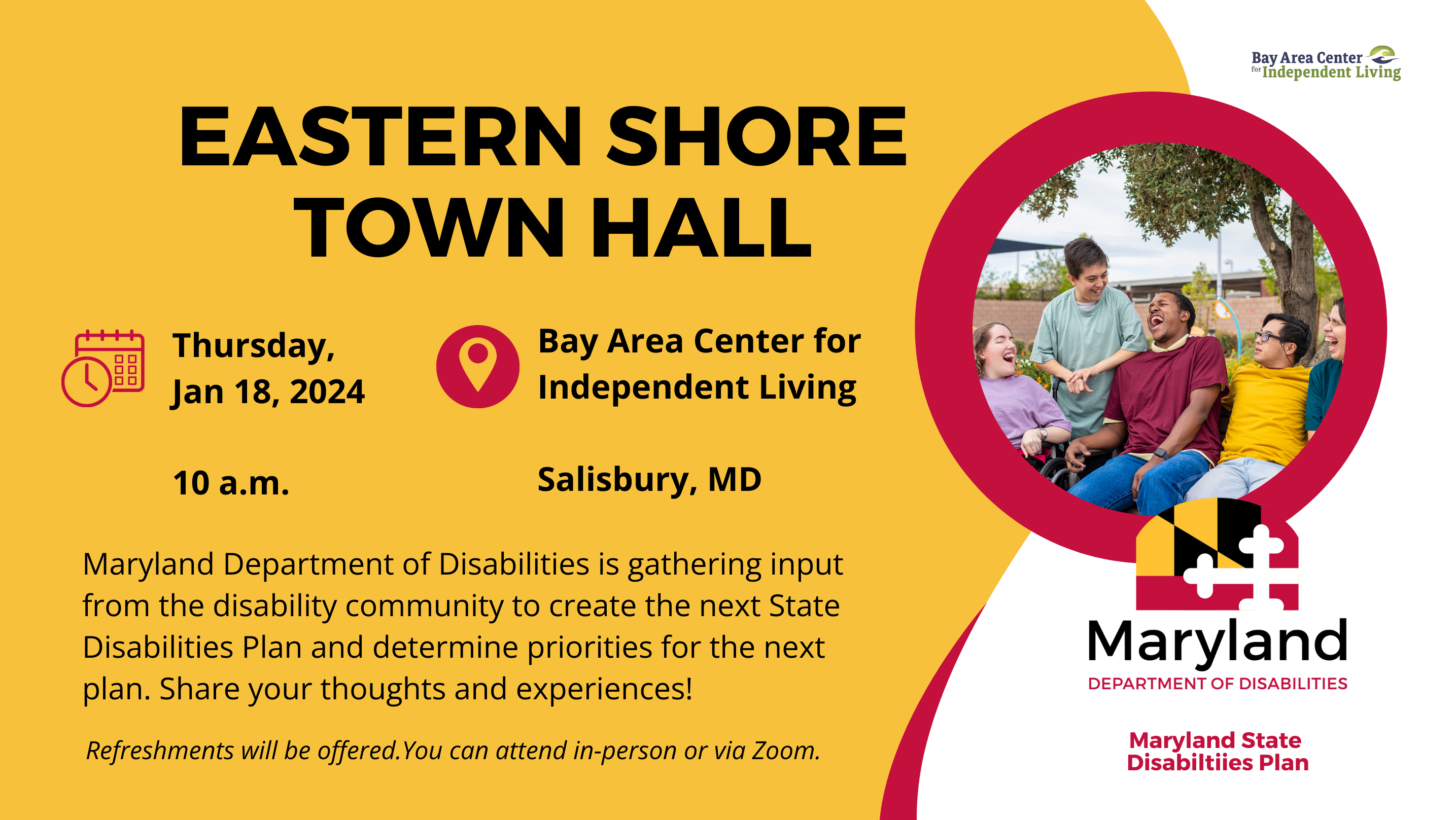
Image ID: Eastern Shore Town Hall. Maryland Department of Disabilities is gathering input from the disability community to create the next State Disabilities Plan and determine priorities for the next plan. Share your thoughts and experiences! To the right is a photo of disabled people with varying disabilities.
You can download the PDF here via Google Drive to share with your networks and individuals who are interested in attending!
Share the Instagram post by clicking here and or Facebook link here.
Please partake in the Eastern Shore Town Hall this Thursday by the Maryland Department of Disabilities at the Bay Center.
The Department of Disabilities is working on its newest State Disabilities Plan.
You may be wondering what the State Disabilities Plan is.
The Disabilities Plan is a roadmap for disabled Marylanders to live a better, more accessible, and equal life. Our current State Disabilties Plan is coming to an end. The prior Plan made an incredible impact on disabled Marylanders.
This Plan will have an even more incredible impact because they are collecting data from disabled individuals in the entire state. These Town Halls allow them to make a more profound impact on disabled Marylanders.
In rural communities like the Eastern Shore, we often lack representation. However, we must be involved because we are affected. Your voice matters!
At the Town Hall, you can share your thoughts on what the state should prioritize as they develop the State Disabilties Plan for the upcoming years.
Some thoughts you can share: affordable housing, self-directed support, transportation, barriers regarding accessibility or resources, etc. Your experiences, thoughts, and questions make a difference!
You can partake in person or virtually!
If you have any questions, please reach out. I’m happy to help, as always.
Image ID: The graphic has photos of the 3 Mayoral candidates; Jermichael Mitchell, Megan Outten, and Randy Taylor. Under are 3 arms of various skin tones holding a vote ballot.
Click the link here to view the responses on the questionnaire from all 3 candidates.
Our elected officials are the ones who make decisions that impact us. When it comes to local elected officials, it matters a lot who represents us. Our Mayors and Councilmembers, for example, are the ones who are creating local legislation, budgets, and engaging with the community.
Local elected officials are the ones who are not only in the community the most, but the ones who understand the community needs. When it comes to the disability community, we need elected officials who understand and will work towards creating the access and inclusion that we need.
Disabled voters deserved to be informed on the issues that matter to us.
The goal of this questionnaire is to understand a general overview of where each candidates stands on the issues that are relevant to us. It’s also to raise awareness of the disability issues that are impacting us.
The candidate questionnaire is non-partisan and has been sent to all 3 candidates.
I had the immense pleasure of celebrating the ADA with the Maryland Department of Disabilities at the U.S. Access Board 2023 Townhall at the National Federation of the Blind in Baltimore.
There representatives of the Maryland Governor’s Office, Lt. Gov. Aruna Miller, and representatives from varying organizations such as the Maryland Developmental Disabilities Council, Disability Rights Network, federal partners, and empowering public speakers.
You can learn more about the speakers and information shared at the Townhall by clicking here.
Being surrounded and empowered by such advocates and champions of those with disabilities was a blessing.
As we celebrate the 33 years of the ADA, I reflect on how lucky I am for the people who fought for our civil rights as disabled people. I think of how these past advocates and activists have crafted a better world for our disability population.
22% of Marylanders have a disability.
Anyone at any time can become disabled and join our community.
It was beyond impactful to see Lt. Gov Aruna Miller present Sec. Carol Beatty a Proclamation on the 33rd Anniversary of the ADA. Not only was the proclamation beyond touching, it was beautiful to see how much Gov. Wes Moore and the Lt. Gov uplift and care for our disability community.
I was honored to speak and share my experiences of living in a rural community during the Town Hall. The Eastern Shore encompasses NINE counties. As I mentioned in my video, I am bordered by the poorest county in Maryland. We need to reach out to the disabled people in these communities. Resources are needed here.
It’s integral to listen to the voices of disabled people, the voices of disabled people in rural communities, and understand the broad spectrum of disability and its intersectionality.
#ThanksToTheADA, I have civil rights. After so many disabled people were treated with institutionalization or had no voice, I am able to be the strong advocate that I am.
However, we need more.
We need to close loop holes.
We need to remember that our work is not done with the ADA.
We need updates to the ADA, we need education on inclusion and ableism, and we need to be able to thrive.
My disability is not my issue. It’s the inaccessibility that surrounds me.
— Dominique Sessa
VIDEO TRANSCRIPT:
Visual description: The video begins with a visual of the U.S. Access Board.It quickly turns to Dominique. She is a white woman with brown curly hair, wearing large frame glasses, a white flowing top. A microphone is in front of her as she speakers.
Text transcription:
Hello, my name is Dominique Sassa. I’m here in Maryland. But I live on the Eastern Shore and especially on the Lower Shore, the resources are very sparse.
If you want to advocate for yourself or you need a resource, it doesn’t exist easily. Our paratransit, like many have said, it’s bad, but it’s even worse in the rural communities. You can’t reach out.
To our paratransit, specifically, you get told they cannot help.My experience with it has been very poor. Ourbuildings, you often can’t go in. I think anyone with a disability understands the experience of waiting out front while their friend who is able to go in the store, the building, and we can’t. That’s often here.
I often have to drivein the streets. And another issue, I think, is very specific to where I live is broadband access. The county next to me, Somerset is actually the poorest county in Maryland.
And how do we reach disabled individuals there if they don’t have broadband? And if the brochures we print are not large print? How do we reach out to them? Not only are disabled people facing barriers— and we’re also facing barriers in the rural communities because we can’t access broadband or resources.
And as a power wheelchair user, I understand.
You know, and too, another issue is that the disability community is diverse. We have the rate of children that are non-native speakers with disabilities rising and it’s hard again to reach out for these resources that we need.
I’ve had issues with my own disability because I have a rare disease and I have to travel 3 hours. A lot people’s primary care is not accessible.
Again because ADA compliance does not equal accessibility.
And to me, I think one of the most important things is to see disabled people thrive. And whether it’s making my wheelchair so I can function independently or being able to reach out to individuals in an accessible format like an e-mail, it does not always exist.
And I think these are issues that are maybe a part of the ADA loophole, but they often keep us chained in place.
My disability is not my issue. It’s the inaccessibility that surrounds me.
(Crowd applause)
“Thank you” is said by Greg who is the Chairman of the U.S. Access Board.
Image Description: Help Paint Kindness for Parkside School. We can gift art! Image of the KRS art kits; lots of supplies are in the art kit. Illustration photo of Dominique holding art and school supplies; she is smiling and wearing a tan, brown sweater and blue jeans. She has dark brown curly hair and wears glasses
Right now, you can help Parkside School in Salisbury Maryland get art kits from KRS Community Project! If we make it to $500, these kits are completely FREE for anyone who wants to participate in this fun community project!
The thing that I love about the KRS Community Project is that it’s inclusive for everyone, no matter their abilities! If we manage to get to the $500, they’ll be free so costs will not be a burden. Right now during this pandemic, our students need us more than ever.
I may have been able to go trick or treating, but I hope to offer my friends over at Parkside this beautiful treat! Watch my Youtube video for more info below:
1st clip: text that reads: The Kindness Rock Project
Brush Strokes of Kindness
Help us Gift Parkside Art!
There are rainbows moving in the corners; the background is pink. At the center is an image of Kind Commissioner Stephanie Willey and Secretary of Kindness, Grace Foxwell-Murdock next to the Kindness banner; Grace has arm outstretched to display the banner.
2nd clip: THE ART OF INCLUSION! There is an image of the kindness banner. There are faces of hand painted rocks, all smiling. Little images of hands raised and pictures that say “hello!” At the corner is a picture of the KRS Community Project Kit
3rd clip: Photo of Dominique, a woman in a power chair, in an inflatable wearing a face mask. Standing next to her is fellow Kind Commissioner, Pastor Martin. Little girl is posed behind her smiling with a painted face
4th clip: Audio clip begins speaking. Dominique is a pink power chair. She is wearing a leopard print, short sleeve shirt and black leggings and a pink Apple watch. Behind her is a black tote bag. Her arms are crossed. She is wearing KIND SBY shoes. Behind her is water, boats. She filmed this in outside Salisbury during mid afternoon.
Audio transcript:
“My name is Dominique Sessa and I’m reaching out today to you friends for you to hopefully donate Parkside School to get these art kits. I believe art is for everyone, including people with disabilities. People who may not be able to afford these kits and you donating to the GoFundMe just proves that. This pandemic has been hard for everyone especially our students. And I think that you donating to this is just proof that art is healing, and you can make a difference for our Parkside students. Salisbury is a city that welcomes everyone and it’s the First World’s Kindness City. As a Kindness Ambassador, as a Kindness Commissioner and as someone who loves kindness, I hope you’ll donate today because I think art is inclusive for everyone. And I hope that you donating even a dollar, you just hope some kindness and love into our Parkside students. Thank you!
5th clip: Photo of Dominique, a woman in a power chair, in an inflatable wearing a face mask. Standing next to her is fellow Kind Commissioner, Pastor Martin. Little girl is posed behind her smiling with a painted face
6th clip: Text reads I’m asking from my heart! It’s animated and a large red animated heart is beating and moving. Photo of Dominique, a woman in a power chair, in an inflatable wearing a face mask. Standing next to her is fellow Kind Commissioner, Pastor Martin. Little girl is posed behind her smiling with a painted face
7th clip: Text reads: Tell me about these art kits?
The KRS Community Project Kit includes everything you need for an inspiring and impactful installation and event.
For our Parkside students, they’ll get $500 worth of art supplies such as postcards, workbooks,
and more! Art that EVERYONE can enjoy!
Image of markers with KRS logos; these are in the art kits. Bottom image of KRS art kits with lots of supplies in it
8th clip: collage of images of people painting the Kindness Banner. Text reads: the creator of these kits also created the kindness banner we brought into sby!
9th clip: Mayor Jake Day joined in on the fun too!Photos of Mayor Jake and Secretary of Kindness, Grace Foxwell-Murdock together. They are posing together with the part he painted for the Kindness Banner and a sign that says “kindness is magic”
10th clip: text reads: Our Kindness Banner brought so much joy to SBY—of all ages! Images of City Administrator Julia Glanz is painting on the Kindness banner; a crowd people is also painting
11th clip: Art is for everyone.
It connects us all especially during this pandemic! Through the KRS Community art kits, the Parkside students can connect and express themselves and channel all of their feelings!
Photos of Salisbury residents, Kind Commissioners, SBY Councilmembers, and youth all painting; some are even in wheelchairs.
12th clip: The Art of Kindness
Learn more about KRS Community Project by visiting their site krscommunityproject.com
Images of painted Kindness Rock. It’s yellow
13th clip: Image of Dominique with Sec. of Kindness, Grace, and Pastor Martin at top
Text reads:
Please donate!
Can’t donate? I understand! Please consider sharing this video so we can help Parkside!
A share is a sign you care!
You rock! Don’t forget [underneath are photos of painted kind rocks on banner]
Image Description: There’s a photo of Leslie. She is smiling, waving. She has black straight hair, is wearing a black waffle knit sweater read black pants. She is waving and is a rigid, manual wheelchair user. Underneath her is a quote of Leslie’s during the video: “I can do all of that from my wheelchair. I don’t have to be able to walk around to do that. And neither do you. – Leslie Jefferson.” Text to the left reads: “Celebrating National Disability Awareness Month on Maryland Eastern’s Shore!” The next clip is an image of the #NDEAM (National Disability Employment Awareness Month) logo. The image features a map of America with many people on it including able-bodied. Text to the right reads: “Thank you Pohanka of Salisbury for celebrating #NDEAM everyday! We love you!” There’s also NDEAM’s official #NDEAM” logo
It was the so wonderful and exciting thing to celebrate #NDEAM with Pohanka Automotive who is leading the way on inclusion – in the workplace and with customers who have disabilities! I’m grateful for the partnerships that exist in my community.
On the Eastern Shore, we are better when partnerships happen!
I was so happy to get a chance to make this video with my friend, Leslie, to share about her career as a disabled woman. Leslie is an amazing disabled Marylander and is doing so much for our Maryland spinal cord community here. Our Lower Shore is so lucky to have her!
To find out more about Pohanka and their business, please click here.
To watch the video, please watch below and share below:
If you need the video transcription, please read below. It has been completely transcribed:
Video transcription:
The video begins with a clip of Leslie talking without sound. She has black straight hair, is wearing a black waffle knit sweater and black pants. She is a rigid, manual wheelchair user. On the clip is text that reads: “Celebrating inclusive workplaces, accessible businesses and disabled employees on the Eastern Shore!”
The next clip is an image of the #NDEAM (National Disability Employment Awareness Month) logo. The image features a map of America with many people on it including able-bodied. The text on the map reads: “ America’s Recovery: Powered by Inclusion.” NDEAM, visit www.dol.gov/ndeam.
Leslie begins to talk (with sound). She is in the Pohamba of Salisbury deanship. Around her are couches and chairs, plants, etc. While talking throughout, she uses her hands and is very moving and animated; speaking and moving poetically.
Leslie is very animated while talking.
The text goes as following:
“Hi everyone, this is Leslie Jefferson. I am actually a buyer for Pohanka Automotive Group. I have been here for going on 10 years and I am a T12 spinal cord injury survivor. So what that means is a little less actually a little less actually than a year ago I was in a car accident that broke my spinal cord on the very low level, which prevents me from having feeling from the waist down. And when that happened, I went into a panic. What am I going to do? Who am I? Can I still work? Can I drive? The things I knew I no longer knew because I couldn’t feel below my waist. But what I found over this past year is that none of these things matter because of the support around me and my employer. I’ve been able to still continue my everyday life, still be able to continue and still be able to drive which is like a really important thing for me even though I can’t use my legs. When I got injured, it was never a question n whether or not I was still going to have my employment. I was still going to have my job. I was still going to my career. My bosses and the people around me just wanted to make do. What do we have to do? Do we have to get you a bigger desk? Do we have to change your position? It was never a question of whether or not I’d be able to do it. There’s a matter of the question of when are we going to do it? When are going to get there? They make sure that at first all I was focused on was physical therapy and getting myself better so that physically and mentally I could come back to work and do the same exact things I did before my injury. And look at me now. I’m still doing that. So I’m still able to roll across Pohanka’s parking lots, show vehicles to customers, executes sales for customers, buy people’s cars. So that’s recently what I’ve been doing. I’ve been buying vehicles from people and I can do all of that from my wheelchair. I don’t to be able to walk around to do that. And neither do you.”
Next clip has text. It reads:
Disabled employees are valuable employees every day! Thankfully, Pohanka honors the contributions of disabled employees and treats them with respect. Inclusive workforces are the best workplaces to foster! More businesses can take notes on how to foster inclusion in the workforce from Pohanka!
There’s a photo of Leslie. She has black straight hair. It’s a selfie. She is pointing to the Pohanka Hyundai building behind her.
Next clip begins with Leslie at work. It reads: “Leslie at work!” Leslie is demonstrating a car and testing its accessibility for customers with disabilities. She wears leggings, a printed top, and is a rigid manual wheelchair user. The video shows her her transferring into the vehicle to test its accessibility and shows how she transfers into cars as someone who is a paraplegic and or a person who uses a wheelchair as an example. The video goes through the process of a transfer, and shows a glimpse of what it looks like.
The transcription goes as following:
“I’m Leslie with Pohanka Hyundai. And today we’re going to start off by showing you a 2022 Hyundai Santa Fe X R and we’re just going to see if I can get in it. We’re really inclusive at the Pohanka and I just wanted to show everybody the difficulties and the pros and cons to different vehicles. So today, we’re going to try this one. I haven’t been in it yet. So let’s see. So for starters, for me, this one, the XR version comes with running boards. For me, in a chair that makes things a little more difficult, but it does look really good. Good! I like the handrail. That was super simple. So yes for this and paraplegic and accessibility, I give the ability to get in the new Santa Fe XR all of the thumbs up.
Next clip is a photo of one of the Pohanka buildings. It is a glass building. Text on image reads: “Thanks Pohanka for being a local business that’s leading on inclusion!”
Next clip is a photo of Leslie. She is wearing dark lipstick, her hair is black with blonde higlights, and she wears a black dress. It is a closeup photo. The text reads: Leslie is incredible and compassionate!
She loves supporting fellow disabled people of any age in finding a career.
She leads with honesty when sharing her daily life struggles that come from having a spinal cord injury. .
She’s also co-founder of the Quad Squad. It’s a Delmarva spinal cord injury FB group. Leslie Jefferson.”
Next clip says: “Thanks for watching the video! Subscribe to my channel for more disability content!” There is a Bitmoji of Dominique; she has olive skin, dark curly hair, wears jeans, a sweater, and checkered Vans. At the bottom is the The Girl in the Pink Wheelchair logo
Image ID: background is a person wearing a white lab-coat and blue medical glove. They are holding a syringe in their hand. On the image is text that reads, “I want my community to be safe. Without all of us doing our part together, it is simply not possible to be safe. We won’t be safe until all of us step up and do the actions necessary – even if it means being brave and doing something we don’t want to do. Sometimes the bravest actions require doing something scary for the greater good. Thank you if you are willing to do that.” At the corner is the logo of The Girl in the Pink Wheelchair.
I received my second vaccine on the 6th of April. I cannot put into words what I feel. None of us thought we would live during a pandemic. I imagine that our ancestors felt this way as they braved pandemics, too. Yet – they survived, too.
Each time that I rolled up my sleeve, I met the nurse who was vaccinating me with such gratitude. I do not recall ever feeling so happy to be this vaccinated before.
I have survived over a year with isolation. I would be lying if I said that I did not feel the isolating aspects of a pandemic. The need to always disinfect, the fear associated. There is a reality of being disabled and living in a pandemic that is unforgotten.
It seems never-ending– and yet, here we are. We have a solution. People are signing up to do vaccines, people are taking them – despite reservations, and people have hope.
I did not take photos of my vaccine nor of the vaccine site. I chose not to share this because I know many people require and NEED this vaccine and cannot get it yet. We have barriers to overcome. We have to overcome the physical barriers, the language barriers, the barriers of caregivers who may not allow their disabled family members to get them (this is a reality), and so many more. We need to dismantle them all.
Those photos should greet you with feelings of warmth if you are scared. I know it can be hard to show you something if you feel that it is out of reach for you.
Instead, I am writing you words. These are words I pen from my soul and my heart. These are words written by a young woman who is asking you to please listen.
Some disabled people who live with immunodeficiency have it to extremes and cannot make vaccine antibodies. When they get a vaccine, they do not produce the antibodies. When you choose to be vaccinated, you are protecting those people. I have a mild immunodeficiency and NMD– and the common cold (if you believe COVID-19 is one) is a killer for me.
When you take a vaccine, you are doing it for a lot of people. Even if you choose it because you want to simply live your life again, you’re making life safe again for our vulnerable populations.
That’s the thing. Sometimes our most vulnerable can’t say “YES” – even if they want it. They wish that they could be in your shoes for a day to get in line for that vaccine! No matter how deserving they are of that vaccine, they may not be able to access it. It’s not fair, but it’s a reality. Vaccines are not always ready and available for our vulnerable populations. Yet when you take one, you help protect our vulnerable populations.
The people who can’t be vaccinated – even if they’re qualified and want to roll up their sleeves. Not everyone can do this act. However, if you can: this is an easy way to protect those of us who need you.
These are the same people who ask you to please wear a mask, even if you don’t like it. You may hate it, but it means a lot for those of us who want to see you, laugh with you, and hug you.
And if you’re scared to be vaccinated, I am not mad at you.
Being scared during a pandemic is normal. New medical procedures are scary. I am at the doctor’s office a lot. The life of disinfectant; the life of hearing about masks is frightening. Nobody wants to live like “this” anymore. I get that. The thing is, our anxiety is at an all-time high.
That small business owner is pretty darn nervous, I assure you. Your neighbor is feeling anxious, even if you may not see it. We are all feeling that fear. If you talk about it, you will see that your feelings are normal. It’s not You vs. Them. We’re all feeling the pressure.
The way to overcome fear is by deciding that we can fight the pandemic together. Let’s agree not to let it swallow us whole. Let’s agree that we can trust science, listen to medicine, and believe that lives are worth more.
Have questions about your vaccine or risks? Your friend who practices medicine will answer them. Talk to your friends and family who were vaccinated. When people trust fear, they forget how strong their faith is. They start disregarding facts. A lot of harm comes from fear-based information. The division is easy.
I didn’t think twice after my specialist told me to get vaccinated. I didn’t get a choice, but to isolate myself. And I refused to miss the choice of being vaccinated.
An EX (!!!!) friend told me last year that “the weakest link would eventually die off,” and that I was causing the pandemic to continue; causing the lockdowns. Ultimately, I was to blame. I was horrified. How could anyone see disabled people as to blame– during a pandemic? Unfortunately, I see a lot of rhetoric where people forget that many disabled people rely on others to make conscious choices.
I’m so appreciative of every person wearing a mask and choosing to get the vaccine even if they hate it, even if they’re scared. If you’re doing the right thing, I am grateful for you.
Please keep doing it.
If you have questions, please don’t be scared to ask them. Learning isn’t anything to be ashamed of. We won’t bridge these gaps unless you ask those questions. Don’t be afraid to say, “I saw this article posted online. Is it true?”
If you want to discuss the vaccine, don’t be afraid to talk about it. Vaccine hesitancy isn’t abnormal. We are are all adjusting, but you rolling up your sleeve makes a difference. It helps protects others– and brings us back to normal. For those who don’t produce vaccine antibodies, it won’t be normal for them. They can’t do that, but you can. Would you say “NO” when it comes to giving blood? Think on that; ponder it. We are still living in a pandemic.
If you still feel scared about rolling up that sleeve, it’s okay. Please just wear your mask, keep your distance, wash your hands. Do the conscious thing. Be a good human being. Kindness is all we have to keep us moving forward.
Thank you if you will roll up your sleeve. If you are still feeling unsure, please don’t feel scared to talk to me, those you trust, community leaders, and others. At the very least – I hope my words make you think of those whose life won’t yet be “normal,” and those don’t always feel comforted by images. I see you. I feel you. I hear you. Most of all, I hope you hear me. I am not mad or sad. I just want you to hug you, love you, and keep spreading love.
I want my community to be safe. Without all of us doing our part together, it is simply not possible to be safe. We won’t be safe until all of us step up and do the actions necessary – even if it means being brave and doing something we don’t want to do. Sometimes the bravest actions require doing something scary for the greater good. Thank you if you are willing to do that. I am grateful for you. When you roll up that sleeve, you are doing something pretty darn incredible, even if you don’t see it that way. I see you. And everyone else sees it too.
Nothing brings me happiness like seeing people I love being vaccinated. I love seeing strangers being vaccinated. I love seeing vaccines being given out – period. It means that I can breathe a little easier now. There is a sense of calmness in this storm for me and my community is safer. You have no idea. It means I can keep serving others in the way I am called in my life to. It means that I can love others.
And most of all – thank you to the vaccinators for getting the vaccines into our arms.
Image Description: To the left is Harriet Tubman. She is a Black woman. She is looking at the camera. She is not smiling, but looks direct and pensive. She is wearing a Victorian outfit. Her hands are crossed together. To the right is text that reads: “Celebrate Harriet Tubman as a Black & Disabled woman. She’s an icon for all especially Marylanders.” logo at bottom
February is Black History Month. If you want to see how Salisbury is celebrating Black History Month, just click here. It includes lots of creative content, a partnership between Fenix Youth INC., and even a focus on locally owned Black small businesses. Love it! Water’s Edge Museum opened this month. Its goal is to tell the stories of Black founding families of the Eastern Shore. It recently also won an award from the Governor’s Office of Service and Volunteerism. Great job, Water’s Edge!
I believe it’s so important to remember during Black History Month the stories of Black Disability history. It can be hard to find these stories. It does not mean that they do not exist. It does not mean that they were not real or that African Americans with disabilities were not living. We have so many leaders in our African American community– whether it be today or then– with disabilities. Disability is a broad identity, as a reminder. African American history is there, just like disability history.
Look at Dr. Henry Louis Gates, for example, or Harry Belafonte. Disability has always existed. The same way that African Americans are apart of our history— whether it be now or then. I think it’s vastly important to think of our history as one, not of separating identifies. I hope for a day when we will see archives of Disability History and Black Disability History, especially here in Maryland.
In this post, I want to focus on an icon that is one of the true trailblazers of African American history. Not just here in Maryland, but globally.
Harriet Tubman.
Harriet was born in Dorchester County on the Eastern Shore of Maryland. She was born into slavery and helped others escape slavery via the Underground Railroad. Let’s not forget, she even was a nurse and a spy during the Civil War for the Union. How cool, right? Can you imagine?!
Harriet lived an incredible life. She’s known best for her abolition, humanitarian and suffrage work.
And she was disabled, too! Did you know that? If you didn’t, it’s okay. Sometimes our media doesn’t always do a good job of portraying or teaching that Harriet was a disabled woman. Sometimes her disability is wrapped into her simply having visions. What does “that” mean exactly? Let’s discuss it.
As a young girl, she sustained a traumatic brain injury. The injury is detailed in the authorized biography of her:
“The overseer caught up a two-pound weight from the counter and threw it at the fugitive, but it fell short and struck Harriet a stunning blow on the head. It was long before she recovered from this, and it has left her subject to a sort of stupor or lethargy at times; coming upon her in the midst of conversation, or whatever she may be doing, and throwing her into a deep slumber, from which she will presently rouse herself, and go on with her conversation or work.”
BRADFORD, SARAH H. HARRIET TUBMAN, THE MOSES OF HER PEOPLE. SMK Books, 2018.
After the injury, Harriet began to see what she described as visions from God. It has been interpreted by many the visions that Tubman had after her injury were seizures, not visions as she said. While we can’t know the diagnosis, we do know that she had a brain injury and neurological symptoms. Later in life, she required surgery to alleviate the pain caused by the injury.
Harriet attributed her visions from God as to how she kept safe. She believed these kept her safe while transporting people on the Railroad. Harriet was always adamant that her visions were a guiding light and centric to her work as an abolitionist working on the Underground Railroad. No matter what her visions were (seizures, another neurological disorder caused from her injury, etc): her disability was central in her work. And she didn’t see it as negative.
In summary, we know that she was having episodes caused from her traumatic brain injury (“TBI”) as a young girl that lead to having her neurological episodes. Some people see Harriet’s description of visions as a misdiagnosis, but I think we can look it as a narrative of her choosing — in her own terms — to reclaim her disability and body, as she sees fit and as she chose.
Harriet’s disability is a huge part of her story. She did all of her amazing work as a Black disabled woman. Like most of her life, Harriet was a trailblazer. By seeing her visions as positive and seeing her injury as something that didn’t define her negatively, she helped pave the way for all disabled people, and especially fellow Black disabled people. She defied the barriers of slavery, racism, classism and ableism, and sexism— as she fought for all people. She was a force of nature.
By seeing her disability as something that was apart of her and strengthening, she helped empower people for generations. Her stories are still empowering people to look at their identities with pride. Harriet reclaimed her life on her terms, nobody else. In 2021, her story is one that is empowering for all, especially Black disabled people.
Harriet is an icon of Black Disability History. It’s an honor to live so near to where she resided for a large majority of her life. How lucky we are to have this wonderful connection to her in the state of Maryland.
She managed to escape slavery and free 70 people. When we talk about Maryland women who lead the way, we cannot stop talking about Harriet. She was a person of color, a person with a disability, and a woman who defied odds. All aspects of her identities deserve praise, including her role as a disabled woman.
Thanks to trailblazers like Harriet for paving the way– for all people. Her legacy is not forgotten.
If you’re interested in virtually visiting the Harriet Tubman and Maryland’s Underground Railroad Tour (safe and accessible to all), you can do so by visiting Eventbrite here. There are lots of links on Youtube too.
P.S. Keep your eyes posted for one more post on African American-Disability history in honor of BHM! While I regret that this is a little late (darn scheduling), I am still excited to share this. These are stories that are relevant year round!